Debt With a Dream, the book cover

Debt With a Dream

The Convertible Bond Field Guide to Risk and Return

Tom Whitley

Convertible bonds promise something unusual: participation in a company’s upside with a debt claim underneath. But that simple description hides a moving mix of stock, credit, volatility, interest rates, time, and contract terms—and every benefit carries a price.

Hardcover and Kindle · Odd Lot Books · Hardcover ISBN 979-8-9975573-0-0
Buy the book

About the book

Debt With a Dream makes that mix understandable. In this intuition-first field guide, Tom Whitley begins with the familiar logic of risk, return, and uncertainty, then builds a practical framework for understanding how convertibles are structured, priced, and used. Along the way, readers learn what the bond floor really protects, why a low coupon can be attractive, how the Greeks shape returns, why “cheap” is not the same as a buy, and how the same security can serve equity, credit, arbitrage, or portfolio objectives.

Clear visuals, worked examples, and plainspoken analysis replace intimidating formulas without sacrificing the nuance. For investors, allocators, advisers, and financial professionals, Debt With a Dream provides the tools to see through market slogans, question assumptions, and decide when a convertible truly belongs in a portfolio.

From the book

The bond is the debt, the contractual claim that can give the thesis time and a defined repayment path if the issuer performs. The warrant is the dream, the participation that keeps upside potential open.

The Convertible in a Portfolio

Most of investing treats uncertainty as the enemy. We spread money across many bets to dilute it, we demand a higher return before we will bear it, and we lose the most sleep over the outcomes we cannot pin down. A convertible does something stranger: it takes that same uncertainty, the thing nearly every other instrument is built to get away from, and turns it into a source of value.

Optionality & Uncertainty

Equity investing trades safety for unlimited upside; debt trades upside for safety. Keep those tradeoffs in mind: a convertible’s whole value proposition is that it doesn’t make you choose between the two.

Debt: The Senior Claim

The convertible doesn’t remove the tradeoffs. It packages a particular mix of them for an uncertain future.

Tradeoffs

Companion tools

Many of the book’s figures and tables have working versions on this site. Each one opens at the values printed in the book. Move the stock price, volatility, credit spread, rates, or time, and the convertible’s value updates as you go.

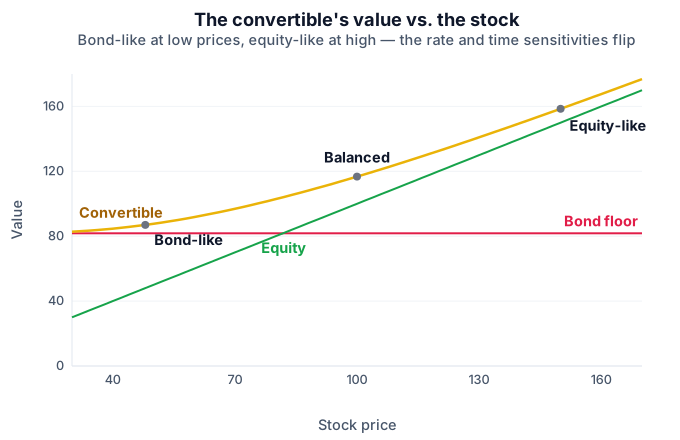
The convertible's payoff: the bond floor, the option, and the two together
The hockey stick, from The Core Idea chapter. Click it to try the inputs yourself.